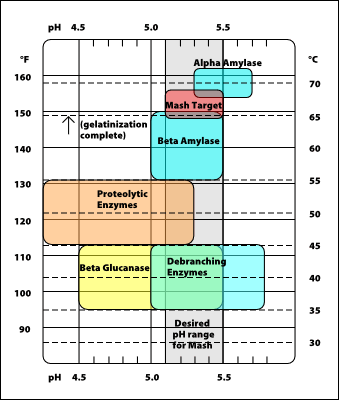
Beta amylase works by hydrolyzing the straight chain bonds, but it can only work on "twig" ends of the chain, not the "root" end. It can only remove one (maltose) sugar unit at a time, so on amylose, it works sequentially. (A maltose unit is composed of two glucose units, by the way.) On an amylopectin, there are many ends available, and it can remove a lot of maltose very efficaciously (like a hedge trimmer). However, probably due to its size/structure, beta cannot get close to the branch joints. It will stop working about 3 glucoses away from a branch joint, leaving behind a "beta amylase limit dextrin."
Alpha amylase also works by hydrolyzing the straight chain bonds, but it can attack them randomly, much as you can with a pair of clippers. Alpha amylase is instrumental in breaking up large amylopectins into smaller amylopectins and amyloses, creating more ends for beta amylase to work on. Alpha is able to get within one glucose unit of a amylopectin branch and it leaves behind an "alpha amylase limit dextrin."
The temperature most often quoted for mashing is about 153°F. This is a compromise between the two temperatures that the two enzymes favor. Alpha works best at 154-162°F, while beta is denatured (the molecule falls apart) at that temperature, working best between 131-150°F.
klistrat från howtobrew.
i ett stort öl tror jag säkert att det kan ha betydelse. kommer nog testa med en ljus stark belgare el iipa.
"You can't be a real country unless you have a beer and an airline. It helps if you have some kind of football team, or some nuclear weapons, but at the very least you need a beer."- Frank Zappa

 Jag är absolut ingen antisockerfundamentalist, jag använder socker i tid och otid. Denna DIPA ville jag testa att se hur lågt ner jag kan komma i utjäsning utan att ha med socker, samt vid vilken lägsta temp man kan ha utan att det ballar ur. Jag har inte direkt fått något svar på den saken så jag testar på 61c.